8618566785362 8618566785362 8618566785362 phoenix08@bbamachine.com
- All
- Product Name
- Product Keyword
- Product Model
- Product Summary
- Product Description
- Multi Field Search
Views: 0 Author: BBA AUTOMATION Publish Time: 2025-10-06 Origin: BBA AUTOMATION


| Product Name | Applicable industries |
| Screw Fastening Unit | Smart Wearables Production |
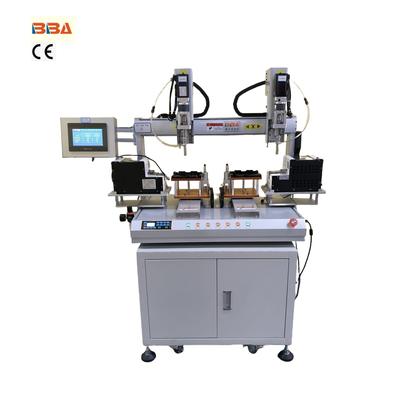
In today's competitive industrial landscape, achieving superior product quality is not just a goal—it's a necessity. Manufacturers across sectors are constantly seeking innovative technologies to improve precision, consistency, and efficiency in their production processes. One of the most impactful advancements in this pursuit is the adoption of multi-axis control systems. This technology has revolutionized automation by enabling unprecedented levels of coordination and accuracy in complex machining and manufacturing operations.
Multi-axis control refers to the ability of a automation system to simultaneously coordinate movement along multiple axes of motion. While traditional systems might manage two or three axes, modern multi-axis solutions can control four, five, or even more axes at the same time. This simultaneous movement allows industrial machinery to perform highly complex tasks with a level of precision that was previously unattainable. The core of this technology lies in sophisticated software algorithms and powerful processors that calculate and synchronize every movement in real-time, ensuring perfect harmony between all components of the system.
The implementation of multi-axis control systems directly enhances product quality through several mechanisms. First, it eliminates the need for multiple setups and repositioning of workpieces. Each time a part is moved or repositioned, there is potential for error introduction and dimensional inaccuracies. By completing complex operations in a single setup, multi-axis control maintains consistent reference points throughout the manufacturing process, significantly reducing cumulative errors.
Second, the technology enables the production of more complex geometries with superior surface finishes. The continuous and fluid movement possible with multi-axis control allows tools to maintain optimal orientation to the workpiece surface, resulting in smoother finishes and more precise contours. This capability is particularly valuable in industries such as aerospace, medical device manufacturing, and automotive, where complex curved surfaces and tight tolerances are common requirements.
The precision offered by multi-axis control systems translates directly to higher quality end products with improved performance characteristics, longer lifespan, and greater reliability in their intended applications.
The benefits of multi-axis control extend across numerous industrial applications. In machining operations, five-axis simultaneous control allows for the creation of intricate parts with complex features that would be impossible to produce with conventional methods. In robotics, multi-axis coordination enables articulated arms to perform delicate assembly tasks with human-like dexterity but far greater consistency.
Additive manufacturing has also embraced multi-axis control, with systems now capable of depositing material along curved paths rather than just layer-by-layer in straight lines. This advancement significantly improves the structural integrity and surface quality of printed components. Similarly, in inspection and measurement systems, multi-axis control allows for comprehensive scanning of complex parts, ensuring thorough quality verification without repositioning artifacts.
Successfully implementing multi-axis control technology requires careful planning and expertise. The initial investment goes beyond hardware to include specialized programming tools and operator training. However, the long-term returns in terms of quality improvement, reduced scrap rates, and decreased rework typically justify the investment many times over.
Modern multi-axis systems are increasingly user-friendly, with intuitive programming interfaces that simplify the creation of complex motion paths. Simulation capabilities allow operators to visualize and verify processes before execution, minimizing the risk of errors and collisions. These advancements have made the technology accessible to a wider range of manufacturers, not just large corporations with extensive engineering resources.
As industrial demands for higher precision and more complex products continue to grow, multi-axis control technology will play an increasingly central role in manufacturing quality enhancement. The integration of these systems with emerging technologies like artificial intelligence and IoT connectivity will further amplify their capabilities, enabling predictive adjustments and self-optimizing processes that maintain perfect quality even as conditions change.
Manufacturers who embrace multi-axis control today are positioning themselves at the forefront of quality manufacturing, ready to meet the increasingly stringent demands of global markets. The technology represents not just an improvement in automation capabilities, but a fundamental shift in how we approach precision manufacturing—where quality is engineered into every movement of the process.