8618566785362 8618566785362 8618566785362 phoenix08@bbamachine.com
- All
- Product Name
- Product Keyword
- Product Model
- Product Summary
- Product Description
- Multi Field Search

Views: 0 Author: BBA AUTOMATION Publish Time: 2025-09-28 Origin: BBA AUTOMATION


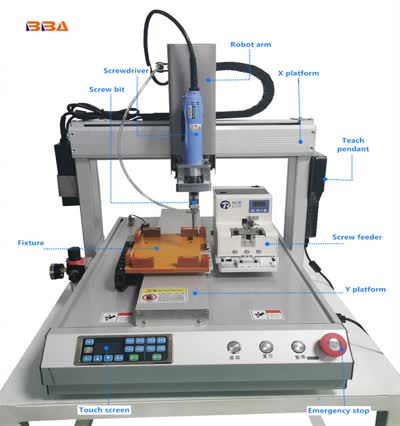
| Product Name | Applicable industries |
| CNC Screw Fastener | Telecommunication Equipment Assembly |
In modern manufacturing, efficiency and precision are paramount. Screw locking robots have emerged as critical tools in assembly lines, offering unparalleled consistency and speed. However, not all production environments are the same. Different industries and applications require tailored approaches to automation. Optimizing these robots for specific needs ensures maximum productivity, reduces errors, and enhances overall operational flexibility.
Before deployment, it is essential to analyze production requirements thoroughly. Factors such as screw size, torque specifications, material compatibility, and cycle times must be considered. For instance, electronics manufacturing may involve small, delicate screws requiring minimal torque, while automotive assembly might demand higher torque for larger fasteners. Environmental conditions, such as temperature and humidity, can also impact performance. By understanding these variables, engineers can configure robots to meet exact specifications, ensuring reliable and efficient operation.
Screw locking robots are versatile and can be adapted for various applications. In high-volume production, speed is crucial. Robots can be optimized with multi-spindle heads or parallel processing capabilities to handle multiple screws simultaneously. For low-volume, high-mix production, flexibility is key. Quick-change tooling and programmable settings allow robots to switch between different screw types and tasks with minimal downtime. Additionally, integration with vision systems and sensors enables real-time adjustments, ensuring accuracy even with complex or irregular components.
Advanced software plays a vital role in optimization. Modern control systems allow for precise torque and angle monitoring, data logging, and error detection. This not only improves quality control but also facilitates predictive maintenance, reducing unexpected downtime.
As production needs evolve, scalability becomes important. Modular robot designs enable easy upgrades or reconfiguration for new tasks. For example, adding end-of-arm tooling or updating software can expand functionality without replacing entire systems. This adaptability is particularly valuable in industries with rapidly changing product designs, such as consumer electronics or medical devices. By investing in scalable solutions, manufacturers can future-proof their operations and respond quickly to market demands.
Seamless integration with existing production systems is another critical aspect. Screw locking robots must communicate with other machinery, such as conveyors, feeders, and inspection systems. Using standardized communication protocols like IO-Link or Ethernet/IP ensures compatibility and simplifies setup. Moreover, Industry 4.0 technologies enable data exchange for centralized monitoring and analysis. This connectivity supports optimized workflow management, providing insights into performance metrics and identifying areas for improvement.
Optimizing screw locking robots for various production needs is not a one-size-fits-all process. It requires careful planning, customization, and continuous improvement. By focusing on specific requirements, adapting to diverse applications, enhancing flexibility, and improving integration, manufacturers can unlock the full potential of automation. These efforts lead to higher quality products, reduced costs, and increased competitiveness in the global market. As technology advances, the capabilities of screw locking robots will continue to expand, offering even greater opportunities for innovation and efficiency.