8618566785362 8618566785362 8618566785362 phoenix08@bbamachine.com
- All
- Product Name
- Product Keyword
- Product Model
- Product Summary
- Product Description
- Multi Field Search

Views: 0 Author: BBA AUTOMATION Publish Time: 2025-07-28 Origin: BBA AUTOMATION


Programming Servo Screw Drivers for Different Screw Patterns
Industrial automation has revolutionized manufacturing, with servo screwdrivers playing a pivotal role in assembly lines. These precision tools offer unmatched control over torque, speed, and angle, ensuring consistent and reliable fastening. However, optimizing servo screwdrivers for various screw patterns requires careful programming to maximize efficiency and minimize errors.
The foundation of effective programming lies in understanding the screw pattern requirements. Linear patterns, circular arrangements, and staggered configurations each demand specific approaches. For linear patterns, programmers must define the pitch distance between screws and implement precise positioning logic. Circular patterns require angular calculations and radius parameters to maintain uniform spacing.
Torque profiling is another critical aspect of servo screwdriver programming. Different materials and screw sizes require varying torque values to achieve optimal clamping force without damaging components. Modern servo systems allow for dynamic torque adjustment during the fastening process, enabling smooth transitions from rapid approach to final tightening.
Advanced programming techniques include implementing error detection routines. These can identify cross-threading, stripped screws, or misaligned parts by monitoring torque curves and rotational position. When anomalies are detected, the system can automatically initiate corrective procedures or halt operations to prevent further damage.
Integration with robotic systems adds another layer of complexity to programming servo screwdrivers. Coordinate transformations must be precisely mapped between the robot's movement and the screwdriver's operation. This requires synchronization of motion profiles and careful timing to ensure the tool engages properly with each fastener location.
For complex assembly operations, programming sequences may involve multiple tools working in coordination. This demands sophisticated communication protocols between devices and careful sequencing to prevent collisions while maintaining optimal cycle times. Simulation software can help verify these programs before implementation on the production floor.
As industrial automation continues to evolve, programming methods for servo screwdrivers are becoming more intuitive. Many modern systems offer graphical interfaces that simplify the creation of complex patterns, with drag-and-drop functionality for positioning and parameter setting. However, a deep understanding of the underlying principles remains essential for troubleshooting and optimization.
The future of servo screwdriver programming lies in artificial intelligence and machine learning. Predictive algorithms may soon automate the optimization of screw patterns and fastening parameters based on real-time performance data, further enhancing quality and productivity in automated assembly processes.
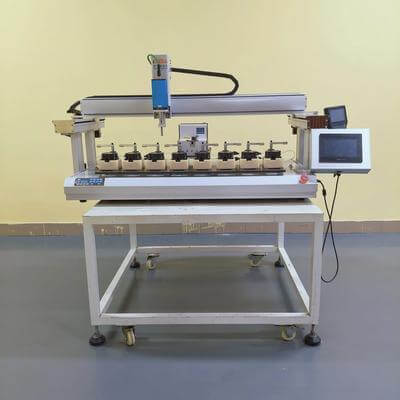
| Product Name | Applicable industries |
| Smart Screw Driving Machine | Smart Wearables Production |