8618566785362 8618566785362 8618566785362 phoenix08@bbamachine.com
- All
- Product Name
- Product Keyword
- Product Model
- Product Summary
- Product Description
- Multi Field Search

Views: 0 Author: BBA AUTOMATION Publish Time: 2025-06-28 Origin: BBA AUTOMATION


| Product Name | Applicable industries |
| Inline Screw Locking System | Medical Device Manufacturing |
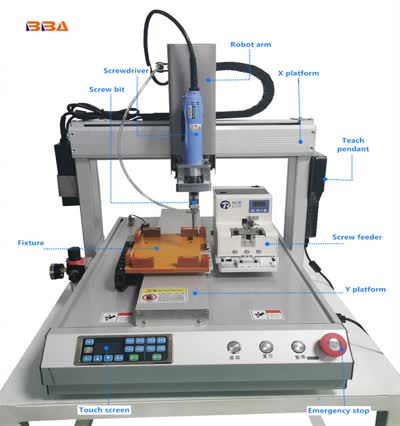
The evolution of automated fastening systems has revolutionized modern manufacturing, and at the heart of this transformation lies the multi-axis screw driver. These robotic systems are pivotal for assembling complex products with precision and speed across electronics, automotive, and consumer goods industries. What makes them truly revolutionary isn’t just their programmed efficiency, but their underlying modular architecture.
Modularity fundamentally transforms how multi-axis screw drivers are designed, deployed, and maintained. By breaking down the system into standardized, interchangeable components—such as torque units, bit changers, axis modules, and feed systems—engineers can customize solutions with surgical precision. Need to shift from M1.6 screws to M5, integrate a vision camera, or add vertical reach? Modular swap reduces complex mechanical redesigns to quick component exchanges, cutting engineering lead times by over 60%. It’s scalability without reinvention: a single chassis can expand from a 3-axis desktop unit for electronics boards to a 7-axis ceiling-mounted giant for automotive dashboards.
Downtime becomes marginal in modular systems. If a servo motor in a Z-axis unit malfunctions, operators extract it via tool-free latches—much like changing a PCB—and replace it within minutes rather than disassembling the entire machine. Front-loading access points prevent production-area bottlenecks. This component-level reparability slashes maintenance costs, extending operational lifecycles by allowing phased upgrades. Outdated control modules? Swap them without replacing torque arms or feeding tubes, preserving capital investments.
Beyond hardware flexibility, modularity streamlines IoT integration. Each standardized block houses its own diagnostics sensors and data ports—think 9-pin M12 connectors—enabling plug-and-play monitoring. Operators identify torque fluctuations from Axis Module C or bit wear errors via dashboards, transforming predictive maintenance. This granular insight helps optimize tightening sequences in real-time: for example, adjusting depth sensitivity when switching between aluminum alloys and carbon composites in aerospace assembly.
Cost efficiency is equally transformative. Manufacturers avoid "overbuying" capability; they deploy minimal configurations and scale modules as demand surges. A medical device line assembling pacemakers might start with four compact axes and later add anti-vibration stabilizers for heavier battery housings—no full-system overhaul required.
Ultimately, modular components are redefining flexibility in industrial automation. They offer adaptable, resilient architecture that anticipates tomorrow’s unknown production variables—material innovations, regulatory shifts, or unplanned order spikes. As factories accelerate toward smart manufacturing, multi-axis screw drivers built on modular principles become less like static machinery and more like dynamic productivity engines—precisely tuned, infinitely rebuildable, and ready for change.