8618566785362 8618566785362 8618566785362 phoenix08@bbamachine.com
- All
- Product Name
- Product Keyword
- Product Model
- Product Summary
- Product Description
- Multi Field Search

Views: 0 Author: BBA AUTOMATION Publish Time: 2025-09-25 Origin: BBA AUTOMATION


| Product Name | Applicable industries |
| Smart Screw Driving Machine | Toy and Game Console Production |
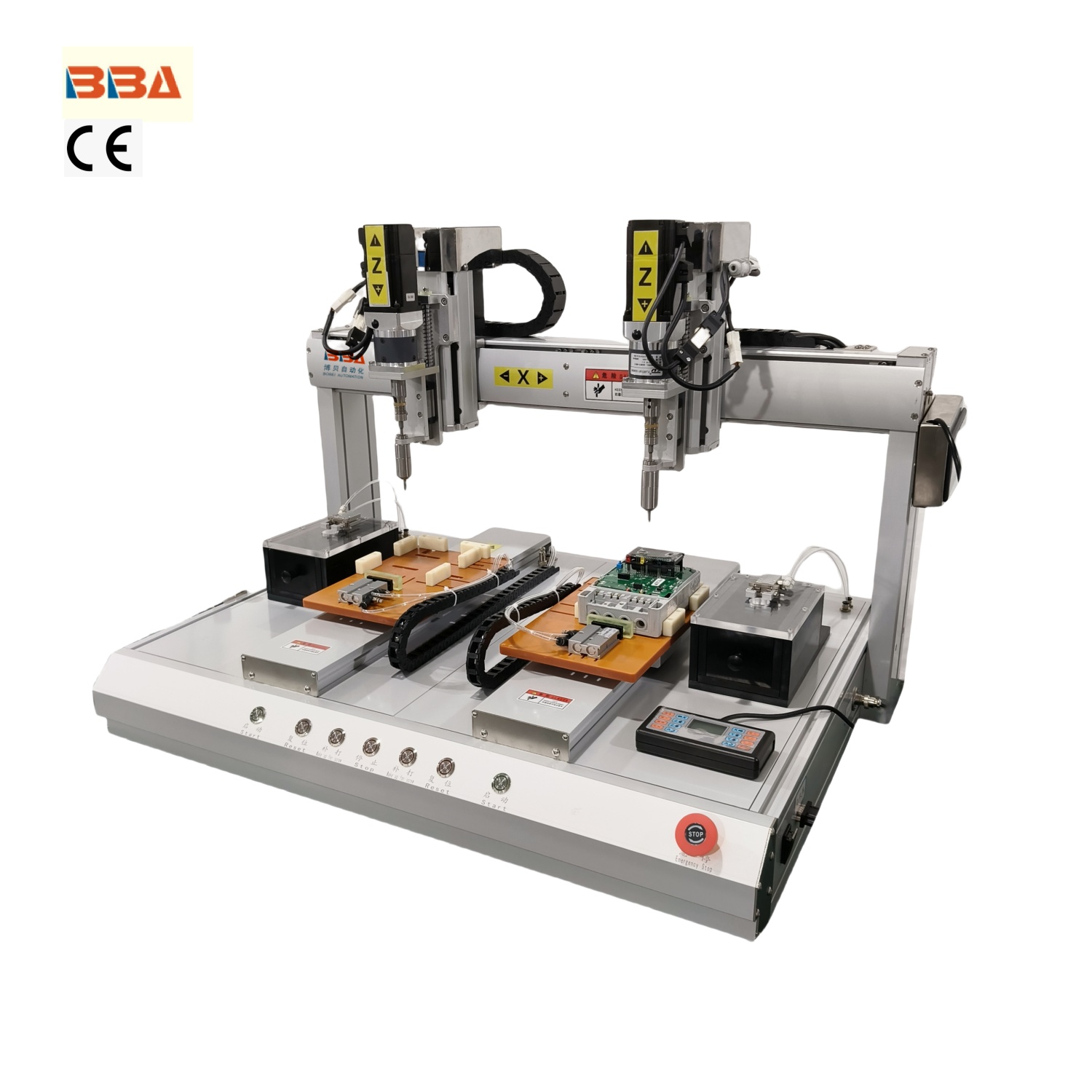
In the rapidly evolving landscape of industrial automation, integrating multiple processes into a single, streamlined operation has become a key strategy for enhancing efficiency, precision, and productivity. One of the most impactful integrations is the combination of dispensing and robotic screw driving technologies. This synergy not only optimizes manufacturing workflows but also opens new possibilities for innovation and quality assurance.
Dispensing systems are widely used in industries such as electronics, automotive, and consumer goods for applying adhesives, sealants, lubricants, and other materials with high accuracy. Meanwhile, robotic screw driving automates the fastening process, ensuring consistent torque and reducing the risk of human error. By merging these two functions into a cohesive unit, manufacturers can achieve a seamless assembly process that minimizes handling, reduces cycle times, and improves overall product reliability.
The integration of dispensing and robotic screw driving offers several compelling advantages. First, it eliminates the need for separate workstations, saving valuable floor space and reducing material transfer between stages. This consolidation leads to a more compact production line and lower operational costs.
Second, combining these processes enhances precision and repeatability. For instance, in applications where adhesives are used alongside mechanical fasteners, the robotic system can first dispense the exact amount of adhesive required and then immediately drive the screw into place. This ensures optimal bonding and fastening without delays or misalignments that might occur if the processes were separated.
Third, this integration supports better quality control. With sensors and vision systems often embedded in modern automation equipment, the combined system can verify the presence and correct application of adhesives, as well as monitor screw driving parameters such as torque and depth. Any deviations can be detected in real-time, allowing for immediate corrections and reducing the likelihood of defects.
The versatility of combined dispensing and screw driving makes it suitable for a wide range of applications. In the electronics industry, for example, it is used to assemble devices where components must be both glued and screwed for added security and vibration resistance. Automotive manufacturers employ this technology for installing interior panels, sensors, and electrical modules that require sealing and fastening. Similarly, in aerospace and medical device production, where precision and reliability are critical, integrated systems ensure compliance with stringent standards.
Moreover, the flexibility of robotic automation allows for easy adaptation to different product designs and volumes. Whether for high-volume mass production or customized, low-volume batches, the system can be programmed to handle varying dispensing patterns and screw types with minimal changeover time.
As industries continue to embrace smart manufacturing and Industry 4.0 principles, the integration of dispensing and robotic screw driving is expected to become even more sophisticated. Advances in artificial intelligence and machine learning will enable predictive maintenance, self-optimization, and greater autonomy. Additionally, the rise of collaborative robots (cobots) will make these integrated systems more accessible to small and medium-sized enterprises, further democratizing advanced automation.
In conclusion, the combination of dispensing and robotic screw driving represents a significant step forward in industrial automation. By unifying these processes, manufacturers can achieve higher efficiency, improved product quality, and greater flexibility. As technology continues to evolve, this integration will undoubtedly play a pivotal role in shaping the future of manufacturing.